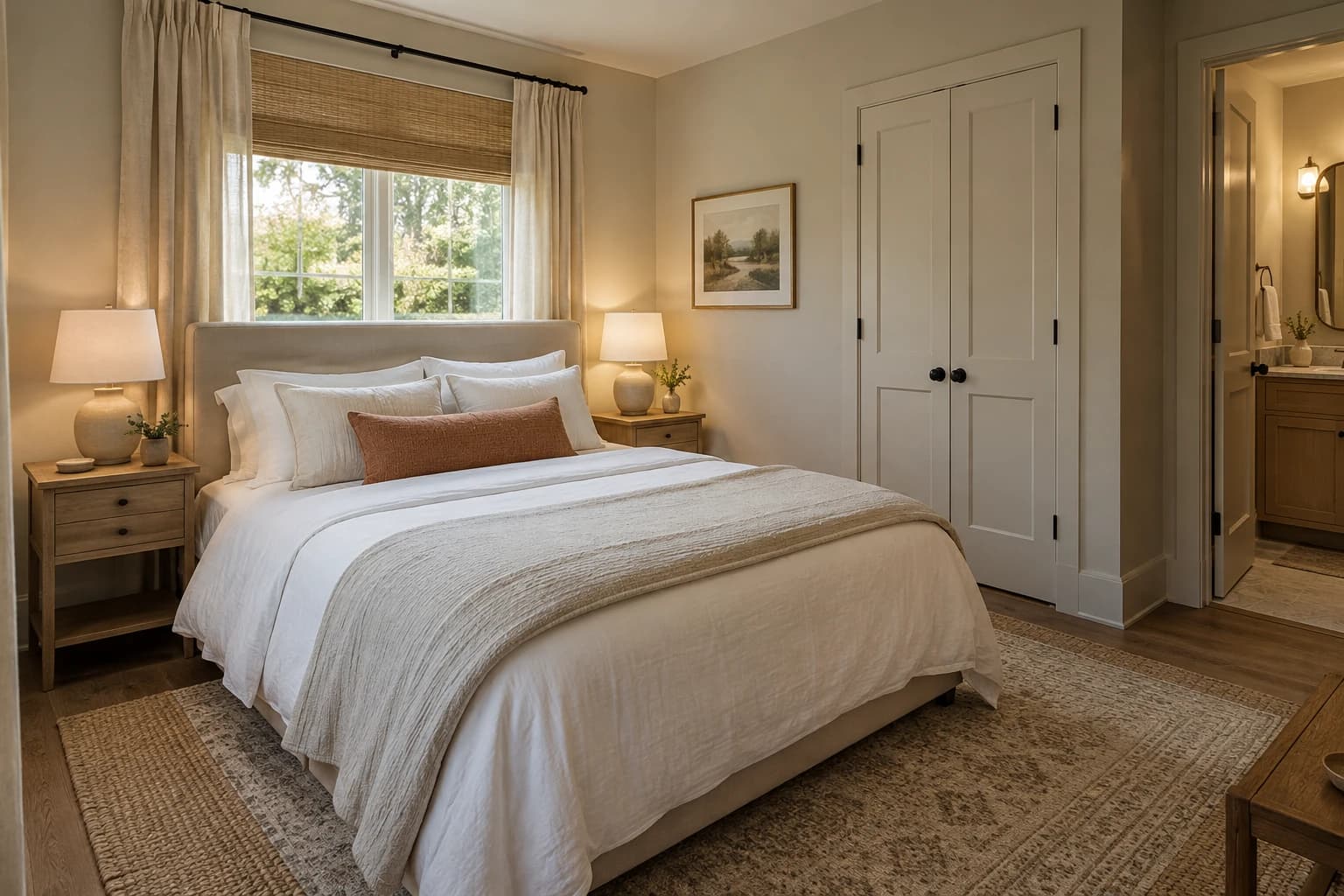
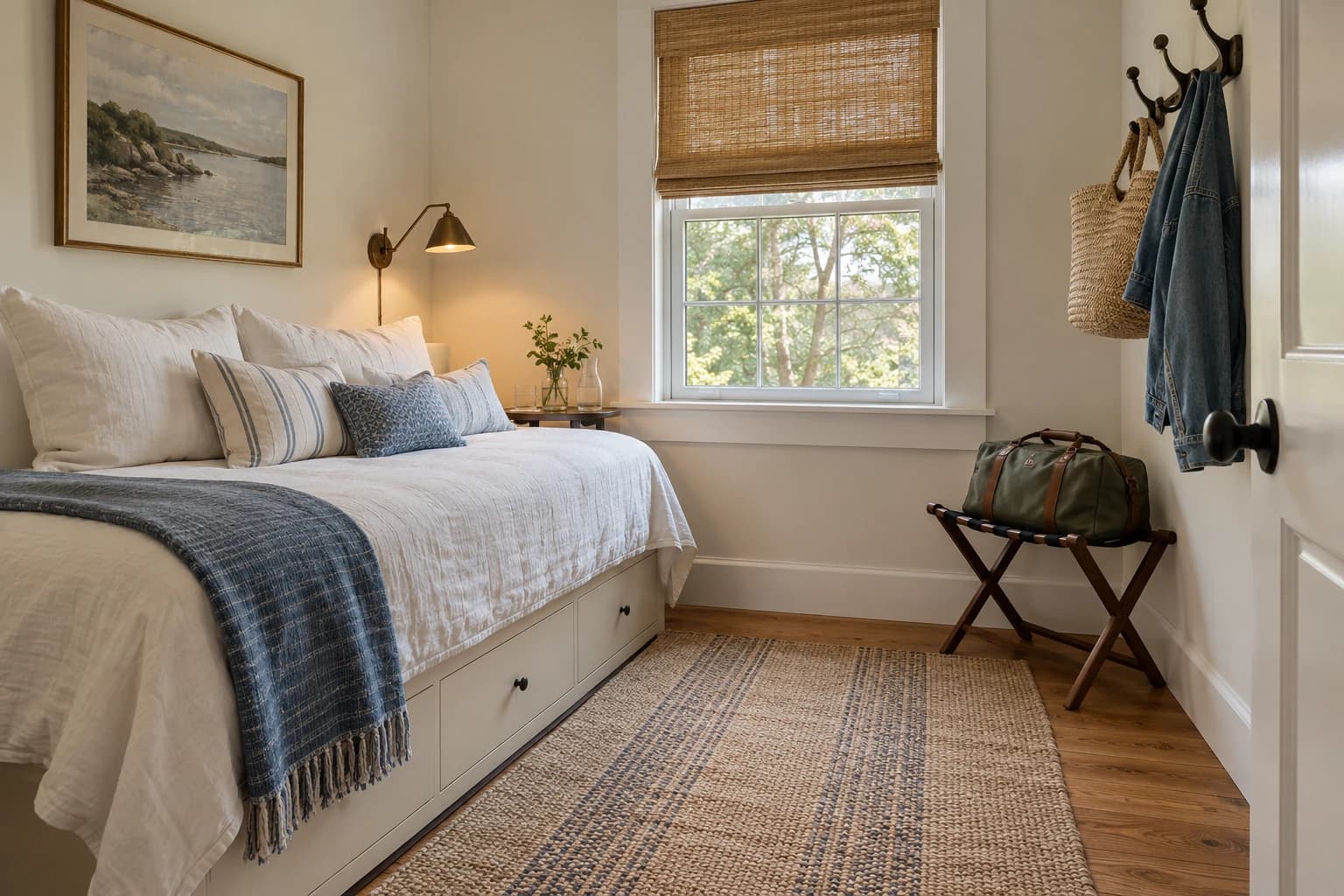
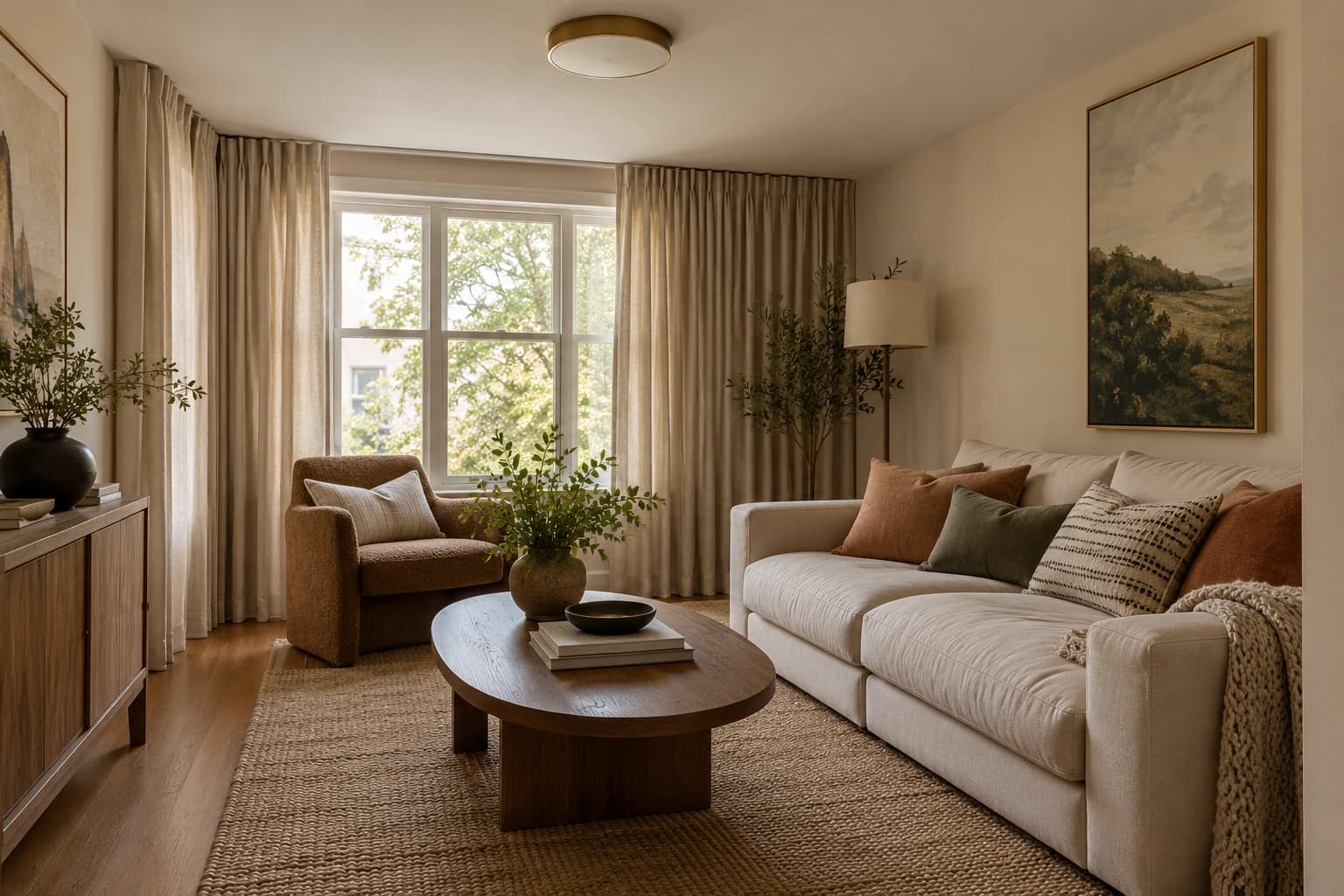
The best small bedroom decorating ideas are to choose a quiet style such as Japandi or Scandinavian, keep the bed low and the floor visible, and move storage under the bed and up the walls. A small bedroom does not need to be bare. It needs a calm palette, furniture at the right scale and a plan for everything you own. This guide covers styles, bed size, storage, low ceilings and the small details that make a compact bedroom feel finished.
Small Bedroom Decorating Ideas: Which Styles Work?
Bedrooms are for rest, so the best styles for small ones are the quiet ones. Our guide to the best interior design styles for small spaces picks Japandi and Scandinavian as the safest choices for a small bedroom, because both aim for calm.
Japandi
Japandi combines Japanese and Scandinavian simplicity, with muted neutrals, natural materials and low furniture.
- Best for: Small bedrooms and low ceilings.
- Why it works: Low pieces leave the wall above them clear, which makes the ceiling feel higher.
- Watch out for: A bed so low that it is hard to get out of. Test the mattress height.
Scandinavian
Scandinavian design pairs light walls and pale wood with cozy textiles.
- Best for: Dim, cold-climate bedrooms.
- Why it works: Light surfaces bounce daylight and natural textiles add warmth without adding pieces.
- Watch out for: Cool white in a north-facing room, which can turn gray. Choose a warm white.
Other styles worth a look
| Style | Use it when | Bedroom move |
|---|---|---|
| Coastal | The room gets plenty of sun | Pale walls, linen bedding, a woven pendant |
| Warm modern | You want a cocooning room | Plaster tones, curved bedside tables |
| Jewel box | The bedroom is for evenings | A deep wall behind the bed, light everywhere else |
Deep color is a real option in a small bedroom if you only use it at night. We cover how in dark paint in a small room.
Style is only half of the answer. The bed decides how much room is left.
Bed Size: Choose the Biggest Bed You Can Walk Around
A bed is the largest object in the room, so it sets how much floor you keep. US mattress sizes are standard enough to plan with: a full is about 54 by 75 inches, a queen 60 by 80, and a king 76 by 80.
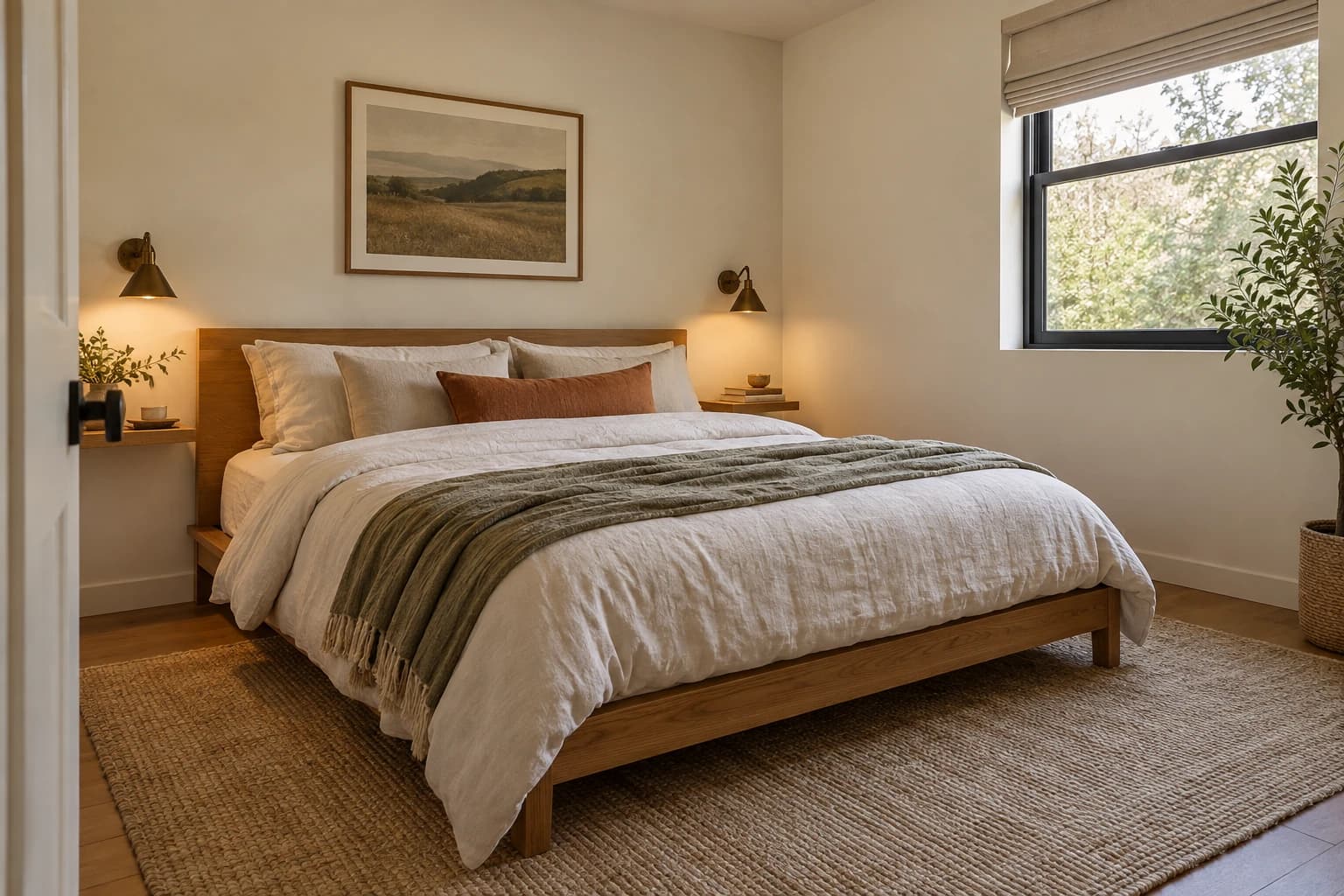
| Mattress | Size (inches) | Footprint | Typical small-bedroom verdict |
|---|---|---|---|
| Twin | 38 × 75 | About 20 sq ft | Fits almost anywhere; best for kids and guest rooms |
| Full | 54 × 75 | About 28 sq ft | Good for rooms under about 10 by 10 feet |
| Queen | 60 × 80 | About 33 sq ft | The usual sweet spot for most small rooms |
| King | 76 × 80 | About 42 sq ft | Only if you can keep walkways on both sides |
Footprints are the mattress dimensions multiplied together, and a frame adds to them. The verdicts are our editorial judgment.
Design guides give 24 to 36 inches as the target for walking space next to the bed, with 30 inches as a comfortable middle. If a bed leaves less than about two feet on both sides, drop a size. We cover this trade-off in more depth in small master bedroom decorating ideas.
Storage in a Small Bedroom: Go Under and Up
Floor space is limited, so storage should use the two places you are not using: under the bed and up the wall.
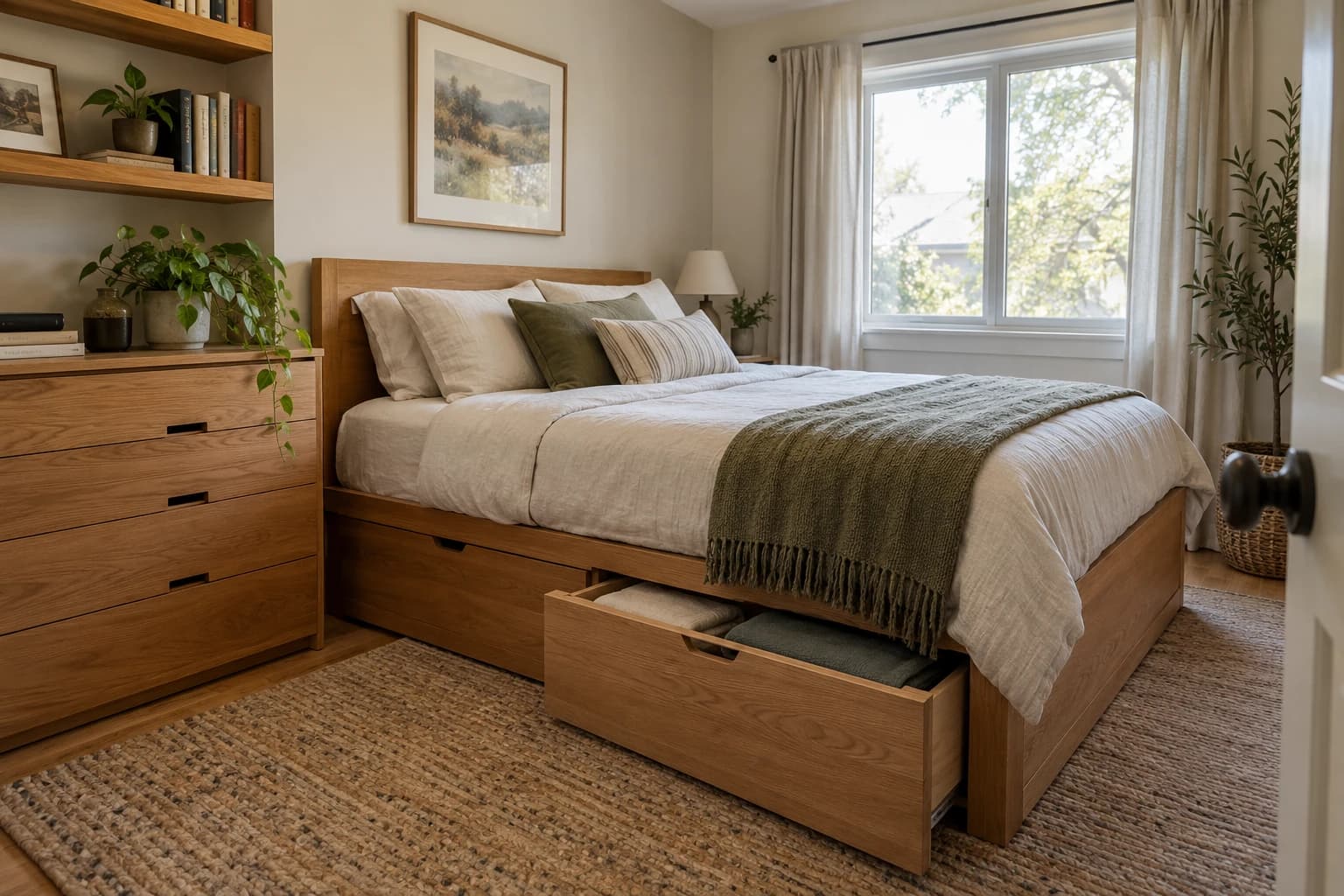
- A storage bed: A frame with drawers acts as a second dresser that takes no extra floor.
- Wall-mounted nightstands and shelves: They free the floor and show more of it, which makes the room read larger.
- Tall, narrow furniture: A tall dresser has the same drawers as a wide one in half the floor.
- Over-door and ceiling-height storage: Use the space above the closet.
- Closed boxes: Edit what you display and store the rest.
For a room that also needs to be used as a guest space, see small guest bedroom decorating ideas.
Low Ceilings: Draw the Eye Up
Many small bedrooms are also low, such as attics, basements and older homes. The advice is consistent across design guides:
- Keep the bed low: A low-profile frame opens the wall above it and makes the ceiling appear higher.
- Hang curtains near the ceiling: Mount the rod high and let the fabric fall to the floor.
- Use vertical lines: Tall mirrors, vertical stripes and tall plants lead the eye upward.
- Light from above and below: Wall sconces and floor lamps help; a heavy pendant can make the ceiling feel lower.
We give this topic more room in low ceiling decorating ideas.
Color, Light and Layered Textiles
- Light walls: Pale colors reflect more daylight. Sherwin-Williams suggests colors above about LRV 65 for small rooms, and notes that paint makers quote thresholds from 50 to 65.
- One palette, three tones: A calm bedroom often uses a pale wall, a mid-tone textile and a dark accent.
- Layer textiles: Linen, wool and boucle add warmth without taking space.
- Mirrors: A large mirror placed opposite or beside a window can double the daylight.
- Layer the lighting: Ceiling light, a bedside lamp for reading and a dimmer in the evening.
- Best for: Bedrooms that feel flat or cold.
- Why it works: Texture and light make a room feel finished without extra furniture.
- Watch out for: Too many patterns. Keep the biggest surfaces plain.
What colors make a small bedroom look bigger?
Light, warm colors with a high light reflectance value, such as soft whites, pale grays and gentle beiges, since they reflect more daylight. Sherwin-Williams suggests going above about LRV 65 for small rooms.
How do you make a small bedroom look nice?
Keep the palette calm, layer the bedding, put lamps at bedside height and clear the surfaces. A small bedroom looks finished when the few things in it are chosen.
What is the 3-5-7 rule for a bedroom?
It groups decor in odd numbers, so a nightstand might hold three items and a dresser five. It keeps surfaces interesting without adding clutter.
How to Layout a Small Bedroom Before You Decorate
Put the bed on the longest solid wall, away from the door swing, and leave a clear path to the window and closet. Before you buy anything, check these three things.
- The door: Does it open fully without hitting the bed or a dresser?
- The window: Is it clear of tall furniture, so daylight reaches the whole room?
- The path: Can you walk from the door to the window and to the closet without turning sideways?
If you answer no to any of them, move the bed first. A small bedroom with a good layout and plain bedding looks better than a styled room with a blocked path.
Small Bedroom Mistakes to Avoid
- A bed too big for the room: It leaves narrow paths and makes the room feel packed.
- Bulky nightstands: Shallow ones, under about 12 inches deep, keep walkways open.
- Blocking the window: Keep tall furniture away from daylight.
- A rug that touches all four walls: It looks like wall-to-wall carpet. Leave a border of floor.
- Using the floor as storage: Boxes and baskets on the floor eat the space you worked to keep.
The SLEEP Method: Five Checks Before You Buy Anything
SLEEP is our editorial checklist for a small bedroom, built on the footprint numbers above: a queen is about 33 square feet of bed, and design guides ask for 24 to 36 inches beside it.
| Letter | Check | Test |
|---|---|---|
| S: Size the bed | Choose the largest bed that leaves a path | Room width minus bed width, halved, is at least 24 inches |
| L: Lift the storage | Go under the bed and up the wall | Nothing important lives on the floor |
| E: Edit the surfaces | Keep nightstands shallow and tops short | Three things on a nightstand, in odd groups |
| E: Eye-line high | Hang curtains and art near the ceiling | The eye travels up, not across |
| P: Path clear | Walk from door to window and closet | No turning sideways |
Our take: Most small-bedroom advice starts with color. We think it should start with the bed, because a bed that is one size too large cannot be fixed with paint.
The Bottom Line
Small bedroom decorating ideas come down to a quiet style, a bed sized for the room, storage that uses the walls and the space under the mattress, and a palette that stays calm. If you are decorating more than one room, our overview of small apartment decorating ideas ties the whole home together.